



Medically reviewed by Shatul L. Parikh, M.D., FACS
Minimally invasive thyroid surgery removes part or all of the thyroid through a smaller incision, usually placed in a natural crease low on the front of the neck. The goals remain the same as conventional thyroid surgery: treat the disease completely, protect the nerves that control the voice, and preserve the parathyroid glands that regulate calcium.
For this article, we asked Shatul L. Parikh, M.D., FACS, one of Northwest ENT and Allergy Center’s thyroid surgeons, to explain how minimally invasive techniques are used in practice. Dr. Parikh has specialized training in minimally invasive thyroid and parathyroid surgery, and his insights throughout this article help explain candidacy, technique, recovery, and when a conventional approach may be safer.
MIT, MIVAT, and How the Surgical Approach Is Chosen
Patients may come across two terms when reading about minimally invasive thyroid surgery: minimally invasive thyroidectomy, or MIT, and minimally invasive video-assisted thyroidectomy, or MIVAT.
Minimally Invasive Thyroidectomy (MIT)
MIT uses a small open incision and direct visualization of the thyroid.
Video-Assisted Thyroidectomy (MIVAT)
MIVAT adds a small camera that magnifies the anatomy during surgery.
Your physician may also combine elements of the two approaches when that provides the best view and access for a particular case.
These are better understood as tools a thyroid surgeon can use, rather than two procedures a patient needs to choose between. In Dr. Parikh’s practice, a minimally invasive incision is typically 3 to 5 centimeters, or about 1 to 2 inches. The final technique depends on factors such as gland size, nodule size, diagnosis, surrounding tissue, and anatomy. In some cases, the exact approach is finalized in the operating room after the surgeon can see the anatomy directly.
Who Is a Candidate for Minimally Invasive Thyroid Surgery?
Minimally invasive thyroid surgery is not appropriate for every patient. According to Dr. Parikh, patients with a small or moderately sized thyroid gland, nodules generally around 3 centimeters or smaller, and no significant inflammation are often good candidates for MIVAT. Somewhat larger glands or nodules may still be treated with MIT.
A conventional thyroidectomy is usually the safer choice in situations involving:
- A large goiter
- A thyroid that extends below the collarbone into the chest
- Significant thyroiditis
- A large, highly vascular gland associated with Graves’ disease
- Previous neck surgery or radiation
- Anatomy that limits safe exposure
- More extensive thyroid cancers or bulky lymph nodes
Even when surgery begins through a smaller incision, the surgeon may need to extend it. That is a safety decision, not a complication. The operation should determine the size of the incision, not the other way around.
Minimally Invasive Thyroid Nodule Surgery
Not every thyroid nodule needs surgery. When surgical removal is recommended, however, some nodules can be treated through a minimally invasive approach. The decision depends on factors such as the nodule’s size, biopsy findings, symptoms, inflammation around the thyroid, the patient’s anatomy, and whether a definitive tissue diagnosis is needed.
For patients with a thyroid nodule, the first question is whether surgery is the appropriate treatment. Thyroid biopsy findings can help guide that decision. For some biopsy-confirmed benign nodules, a nonsurgical option such as thyroid radiofrequency ablation (RFA) may also be worth discussing.
Minimally Invasive Thyroid Surgery vs. Thyroid RFA
Radiofrequency ablation, or RFA, and minimally invasive thyroid surgery are very different treatments.
Thyroid RFA
RFA is nonsurgical. Using ultrasound guidance, a physician places a needle into the thyroid nodule and uses heat to shrink it over time. Nothing is surgically removed, and there is no incision. The nodule remains in the thyroid, which means it can regrow, and some patients may need another treatment later.
Minimally Invasive Surgery
Minimally invasive thyroid surgery still involves removing the nodule, part of the thyroid, or the entire gland. The removed tissue is then sent to pathology for a definitive diagnosis.
Dr. Parikh generally considers thyroid RFA most appropriate for biopsy-confirmed benign nodules causing problems such as pressure, difficulty swallowing, or a visible lump.
Surgery is more likely to be recommended when:
- Thyroid cancer is confirmed or suspected
- A biopsy is indeterminate and cancer cannot be reasonably excluded
- A patient has a large or substernal goiter
- The thyroid contains many nodules
- Graves’ disease or another overactive thyroid condition is involved
- A patient needs or wants a definitive tissue diagnosis
Benefits, Risks, and Recovery
For appropriately selected patients, minimally invasive thyroid surgery can offer a smaller incision, less discomfort during the first few days, and high satisfaction with the cosmetic result, with safety comparable to conventional surgery when performed by an experienced surgeon.
A smaller incision placed in a natural skin crease often heals well, but the final appearance depends on individual healing, skin type, and the tendency to develop a thickened scar. It is not scarless and may still need to be extended for safety. Minimally invasive surgery is also not necessarily faster than a conventional thyroidectomy.
What Recovery May Include
- Many patients can manage postoperative discomfort with over-the-counter medication, although pain and recovery vary.
- Procedure time depends on the diagnosis and how much surgery is required.
- Many patients go home the same day, particularly after a thyroid lobectomy.
- Overnight observation may be appropriate after a total thyroidectomy or when calcium levels, bleeding risk, other health conditions, or distance from the hospital need to be considered.
- Many patients with desk-based jobs return within one to two weeks. Heavy lifting is restricted for a period after surgery, and people who depend heavily on their voice for work may need more recovery time.
For a fuller recovery timeline, read What to Expect After Thyroidectomy.
Important: A smaller incision does not eliminate the standard risks of thyroid surgery. These include potential voice changes and low calcium levels. Patients who have their entire thyroid removed will also need lifelong thyroid hormone replacement.
Minimally Invasive Thyroid Surgery for Thyroid Cancer
A minimally invasive approach may be appropriate for selected patients with small, low-risk differentiated thyroid cancers, particularly papillary thyroid cancers that are confined to the thyroid. Depending on the case, that can include a lobectomy, total thyroidectomy, or selected removal of lymph nodes in the central neck.
A larger incision or conventional approach is usually needed when:
- The tumor is large
- The cancer extends beyond the thyroid into muscle, the trachea, the esophagus, or the nerve that controls the voice
- Bulky lymph nodes are involved, especially when lymph nodes in the lateral neck require removal
- The cancer is a more aggressive type, such as medullary, poorly differentiated, or anaplastic thyroid cancer
- The cancer has returned
- The patient has already undergone neck surgery
Preoperative ultrasound of the thyroid and lymph nodes helps the surgeon plan the operation.
The cancer operation determines the incision, never the reverse.
Why Surgeon Experience Matters
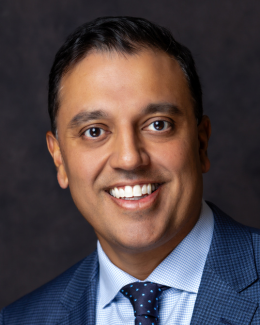
For patients comparing thyroid surgery options, it can be easy to focus on incision length. Dr. Parikh encourages patients to focus first on the experience of the surgeon performing the operation.
Dr. Parikh has performed more than 3,000 endocrine operations. Whether he uses a minimally invasive or standard incision, his priorities remain the same: protect the voice, preserve parathyroid function, and treat the thyroid disease completely.
The safest approach is not always the one with the smallest incision. An experienced thyroid surgeon can evaluate the diagnosis, anatomy, and patient goals and choose an approach that balances those factors without compromising the operation.
View Dr. Parikh’s ProfileMinimally Invasive Thyroid Surgery in Metro Atlanta
Patients considering minimally invasive thyroid surgery in Metro Atlanta can meet with Northwest ENT and Allergy Center to find out whether a smaller-incision approach fits their diagnosis and anatomy.
A consultation can also help determine whether surgery, RFA, monitoring, or another approach makes the most sense for the thyroid condition being treated.
Discuss Your Thyroid Surgery Options
Schedule an appointment with Northwest ENT and Allergy Center to discuss minimally invasive thyroid surgery and find out which treatment approach may be appropriate for you.